
Perfect Binding vs. Saddle Stitch: The Quick Answer
If your piece is under about 60-64 pages and you want the most affordable, fastest option, saddle stitch is usually the right call. If your piece is longer, needs a flat spine for shelving, or you want a more premium, paperback-book feel, perfect binding is the better fit. The rest comes down to a few tradeoffs worth understanding before you finalize your file.
What Is Saddle Stitch Binding?
Saddle stitch binding (also called staple binding or saddle stapling) is a binding method where printed sheets are folded in half and stapled together along that center fold, or “saddle.” It’s the binding you’ll recognize from most magazines, event programs, and short catalogs — the pages open flat, and the spine is just a fold, not a separate glued or bound edge.
Because saddle stitch works by folding large sheets that each become four pages, the total page count of a saddle-stitched piece has to be a multiple of 4, covers included. If your content lands at 22 pages, you’ll need to trim to 20 or expand to 24 — those extra pages can be used for ads, contact info, or an intentional blank page.
“Staple binding” and “saddle stitch binding” refer to the same process — if you’ve seen either term, they’re describing this method.
What Is Perfect Binding?
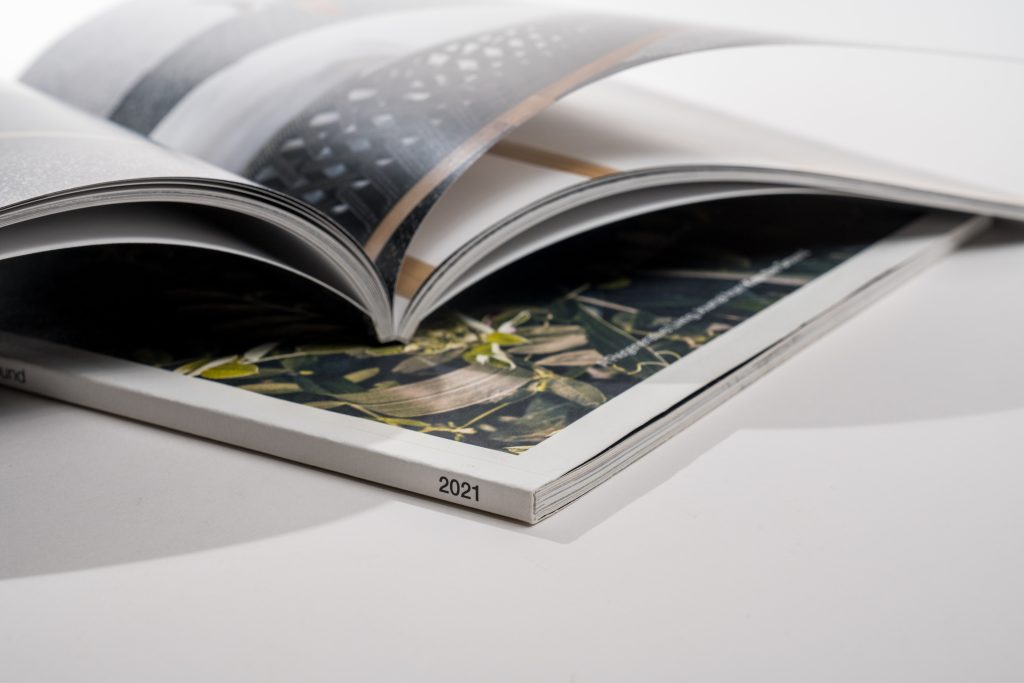
Perfect binding is the method used for most paperback books: individual pages are glued together at a flat spine and trimmed square on all other sides, then a cover wraps around and is glued to that spine. Unlike saddle stitch, perfect binding doesn’t rely on folded sheets, so it isn’t locked into page counts that are multiples of 4 — it handles higher page counts and gives you a flat, printable spine, which is useful for anything that might sit on a shelf.
Perfect Binding vs. Saddle Stitch: Key Differences
| Saddle Stitch | Perfect Binding | |
| Page count | Must be a multiple of 4; typically 8–64 pages | Handles higher page counts, no multiple-of-4 rule |
| Spine | Folded, no flat spine (can’t print spine text) | Flat, square spine (can print title/text) |
| Cost | Lower cost, faster turnaround | Higher cost, more production steps |
| How it opens | Lays open flat, easy to read across the spread | Doesn’t open as flat, especially near the spine |
| Look and feel | Lightweight, magazine-style | More substantial, paperback-book feel |
| Best for | Programs, catalogs, lookbooks, short guides, zines | Manuals, thicker catalogs, self-published books |
How Many Pages Can You Saddle Stitch?
This is one of the most common points of confusion, so it’s worth spelling out clearly: saddle stitch page counts must be a multiple of 4, and most saddle-stitched jobs fall between 8 and 64 pages. Beyond that range, the folded sheets get too thick to staple cleanly through the spine, and the piece will start to bulge instead of lying flat — that’s the point where perfect binding (or another method like Wire-O) becomes the better choice.
What Does Saddle Stitch Binding Look Like?
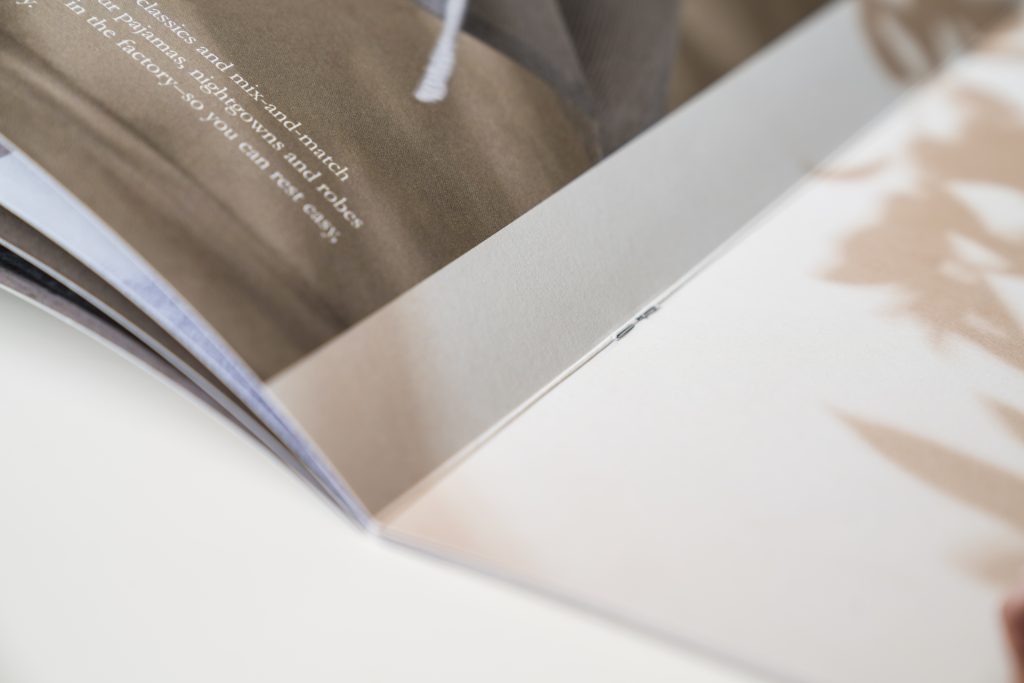
A saddle-stitched piece looks like a small magazine: a single folded spine with one or two visible staples running along the crease, no separate spine panel, and pages that open completely flat across the full spread. There’s no glue or squared edge — just the fold and the staples holding everything together.
What About Wire-O or Spiral Binding?
If your project needs to lie completely flat and fold all the way back on itself — think workbooks, recipe books, or planners — Wire-O or spiral binding is worth a look instead of either saddle stitch or perfect binding. It’s a different tradeoff: more flexibility in how the piece opens, at a different cost and page-count profile than either option above.
Which Binding Should You Choose?
- Choose saddle stitch for: catalogs, lookbooks, event programs, short guides, zines, and anything where cost and turnaround matter more than a flat spine.
- Choose perfect binding for: thicker catalogs, manuals, and self-published or paperback-style books where a flat, printable spine matters.
- Choose Wire-O or spiral for: pieces that need to lie fully flat or fold back on themselves.
FAQ: Quick Answers About Binding Styles
What is saddle stitch binding? A binding method where folded sheets are stapled together along the center fold, commonly used for magazines, programs, and short booklets.
What is the difference between saddle stitch and perfect binding? Saddle stitch uses staples along a folded spine and works best for shorter, page-count-in-multiples-of-4 pieces. Perfect binding glues pages to a flat spine and handles higher page counts with a more book-like feel.
Is saddle stitch the same as staple binding? Yes — “staple binding” and “saddle stitch binding” describe the same process.
How many pages can you saddle stitch? Most saddle-stitched pieces run between 8 and 64 pages, always in multiples of 4.
Is perfect binding more expensive than saddle stitch? Generally, yes — perfect binding involves more production steps (gluing, squaring, trimming), so it typically costs more and takes longer than saddle stitch for a comparable run.
Ready to bring your project to life? Greenerprinter offers a full range of sustainable printing options. Explore some of our most popular products:
Calendar Printing
Custom Calendars | Wall Calendars | Saddle-Stitched Calendars